Rabies in Cats: Transmission, Stages, and Prevention


This article has been reviewed by Dr. Soheyl Simaei on May 26, 2026.

Key Takeaways
Rabies in cats is a highly contagious viral disease with no definitive cure, making vaccination crucial for prevention.
The virus presents with clinical signs between 10 days and 1 year, with 3-8 weeks being common. Death is expected 3-10 days after symptom onset.
Only a direct fluorescent antibody test is capable of accurately diagnosing rabies in cats, but it can only be performed post-mortem.
Summary
Rabies is a deadly disease that affects the nervous system and is nearly 100% fatal once the symptoms appear. The virus is highly contagious and fatal within 3-10 days of symptom onset.
As the disease progresses, cats may experience significant behavioral changes, excessive drooling, weakness, and paralysis.
How do cats get a rabies infection?
Cats exclusively contract rabies through infected animal bites. The virus is active in saliva, and when your cat is bitten, it can easily enter their body. An infected animal's saliva can also cause rabies when it comes into contact with broken skin, open wounds, and mucous membranes.
The rabies virus travels along nerves to the spinal cord and brain. Here, it causes substantial damage to the central nervous system before spreading to other parts of the body. Rabies transmission is an extreme risk for cats and humans.
Prevalence in the UAE
In the United Arab Emirates, reported cases of rabies in domestic cats are rare, largely due to strict pet import laws, widespread vaccination campaigns, and effective municipal control over stray animal populations.
However, the risk is still not zero. Occasional outbreaks involving stray and domestic animals, especially unvaccinated cats and dogs, have prompted local authorities to issue reminders about the importance of keeping pets vaccinated.
Several countries have been declared rabies-free through sustained vaccination and control programs. To support this global cause, it's essential to ensure your cat's rabies vaccination is always up to date.
Clinical signs
After exposure to the rabies virus, there will be an incubation period. This is the time before the symptoms begin to show. For cats, it's typically 3-8 weeks. In rare cases, symptoms may appear as early as 10 days or take several months to develop.
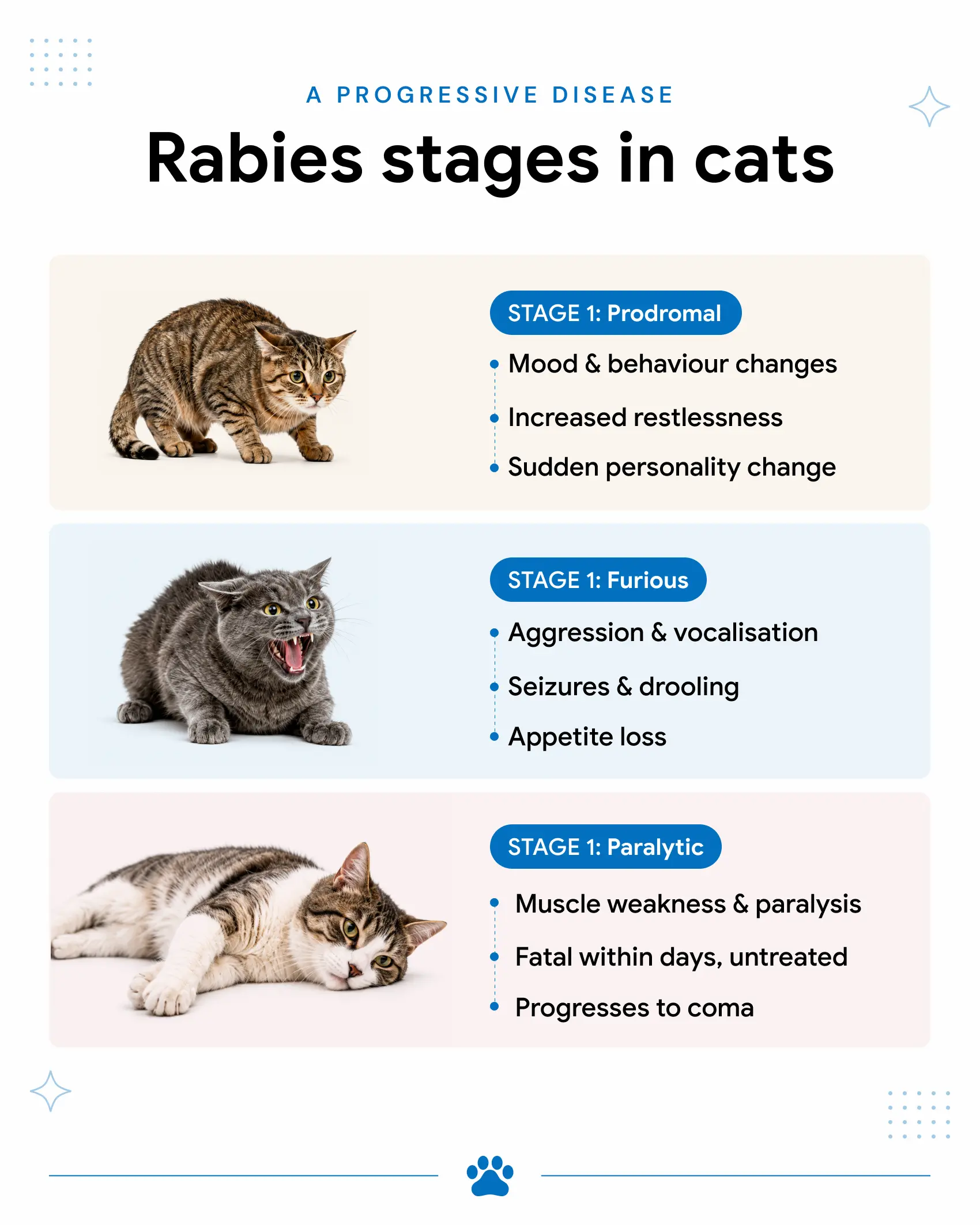
Rabies in cats progresses in stages. Here's an overview explained by Dr. Soheyl:
1. Prodromal Stage (1-3 days)
This is the initial stage of a rabies infection in cats, which typically lasts for about 1-3 days. The prodromal stage is characterised by small and subtle changes in your cat’s behaviour. Common examples include:
Originally shy cats may appear aggressive, while outgoing cats may become withdrawn
Cats may fixate on their wounds and start licking, scratching, or biting them
Persistent or uncharacteristic changes in meowing
Heightened reactions to light, sound, or even touch
General signs such as loss of appetite, fever, and lethargy
2. Furious Stage (1-7 days)
The second stage of the rabies virus's progression. This stage lasts 1-7 days and is the period with the most extreme symptoms and clinical signs, hence the nickname "mad dog" stage. Symptoms include:
Extreme aggression and unprovoked attacks, such as biting and scratching
Hypersensitivity to any form of stimulus, such as light, loud noises, or touch
Attacking invisible objects or getting confused about surroundings
Abnormal vocalisations such as hissing, growling, and yowling
Dilated pupils, excessive drooling or foaming at the mouth, and an anxious posture
Physical convulsions or muscle tremors
3. Paralytic Stage (2-4 days)
In the final stage of the symptoms, which generally lasts 2-4 days, the cat infected with rabies will get progressively weaker until it becomes paralysed. This is why it's also known as the "dumb stage."
At this time, the rabies virus has completely altered the brain and continues to spread throughout the cat’s body. The main symptoms are:
The lower jaw hangs open, appearing like a yawn
Weakness starts in the hind legs and progresses to other parts
Labored breaths, choking, and respiratory failure due to paralysis of the muscles
Unresponsiveness and death
Frequently Asked Questions







MORE THAN A VET VISIT