Ringworm in Cats: How It Spreads and How It's Treated

Updated Date

Updated Date

10 minutes

10 minutes

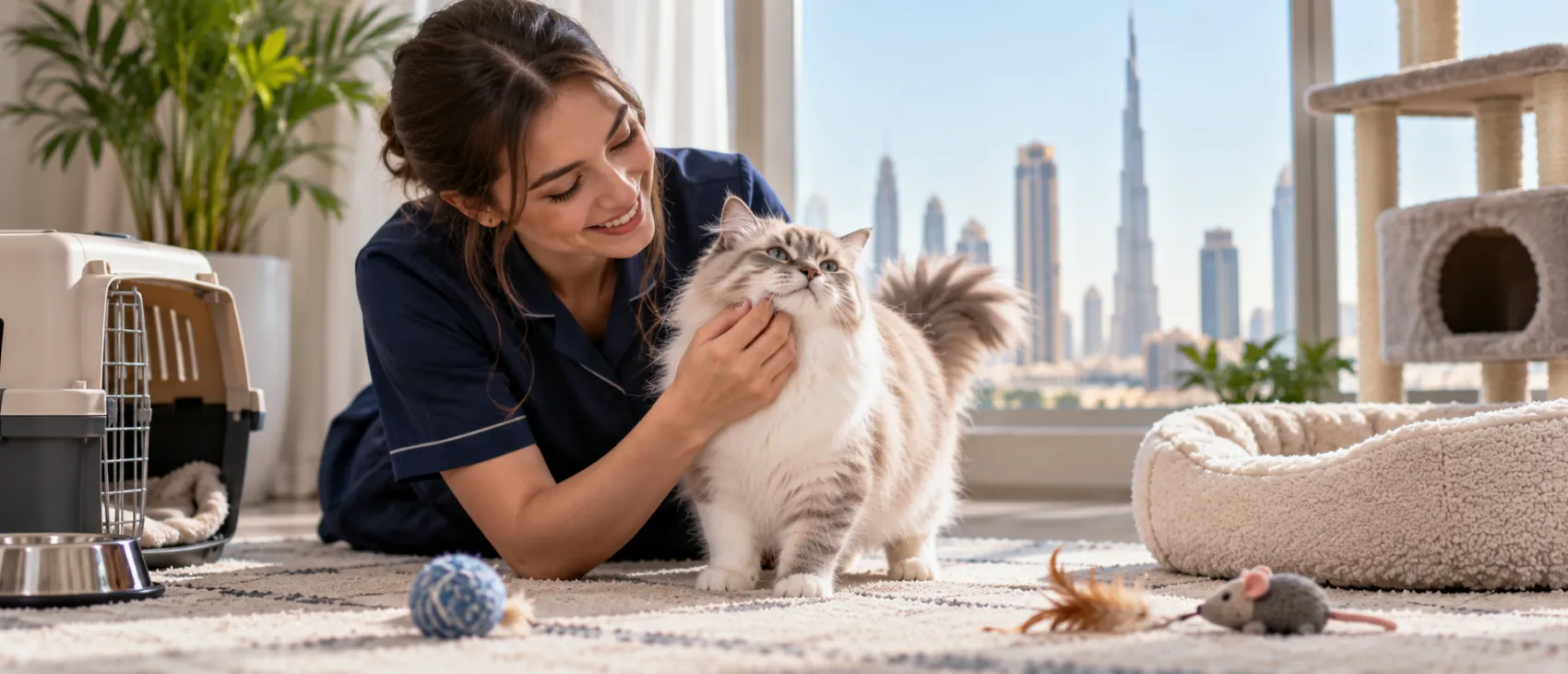
A veterinarian is gently taking care of a cat recovering from ringworm.

In This Article

Key Takeaways

Cats contract ringworm through direct contact with infected animals and people, as well as contaminated objects and surfaces.

Diagnosis involves Wood's lamp examination, microscopic examination, fungal cultures, and a PCR test.

Treatment takes about 6 weeks for recovery, with months for severe cases.

Summary

Ringworm in cats is a highly contagious fungal infection that thrives in Dubai's warm, humid climate. Despite the name, it isn't caused by a worm. It's a fungus that feeds on keratin in the skin, hair, and claws, from a group of organisms called dermatophytes.

Roughly 94–98% of cases in cats are caused by the fungus Microsporum canis, with Microsporum gypseum and Trichophyton mentagrophytes responsible for most of the rest.

Fungal spores shed from an infected cat's coat can stay dormant on carpets, furniture, bedding, and grooming tools for up to 18 months. This is why environmental decontamination matters just as much as treating the cat itself.

Ringworm is also zoonotic, meaning it can spread between cats and people. This is a particularly relevant concern in Dubai, where the widespread use of communal spaces like grooming salons, catteries, and boarding facilities creates more opportunities for spores to spread between animals.

What Does Ringworm Look Like on a Cat

This fungal disease causes significant skin infection. Here are the common symptoms observed by our veterinarians:

  • Ringworm Lesions. Bright red, circular patches on the skin, common on the head, face, tail, and feet.

  • Bald Spots. Irregular or circular patches of hair loss.

  • Broken Fur. The coat may look dull, dry, or brittle, with visible hair breakage.

  • Excessive Grooming. Cats may scratch, lick, or bite the infected area due to irritation.

  • Nail Issues. Claws and nail beds can become brittle, discoloured, rough, or misshapen.

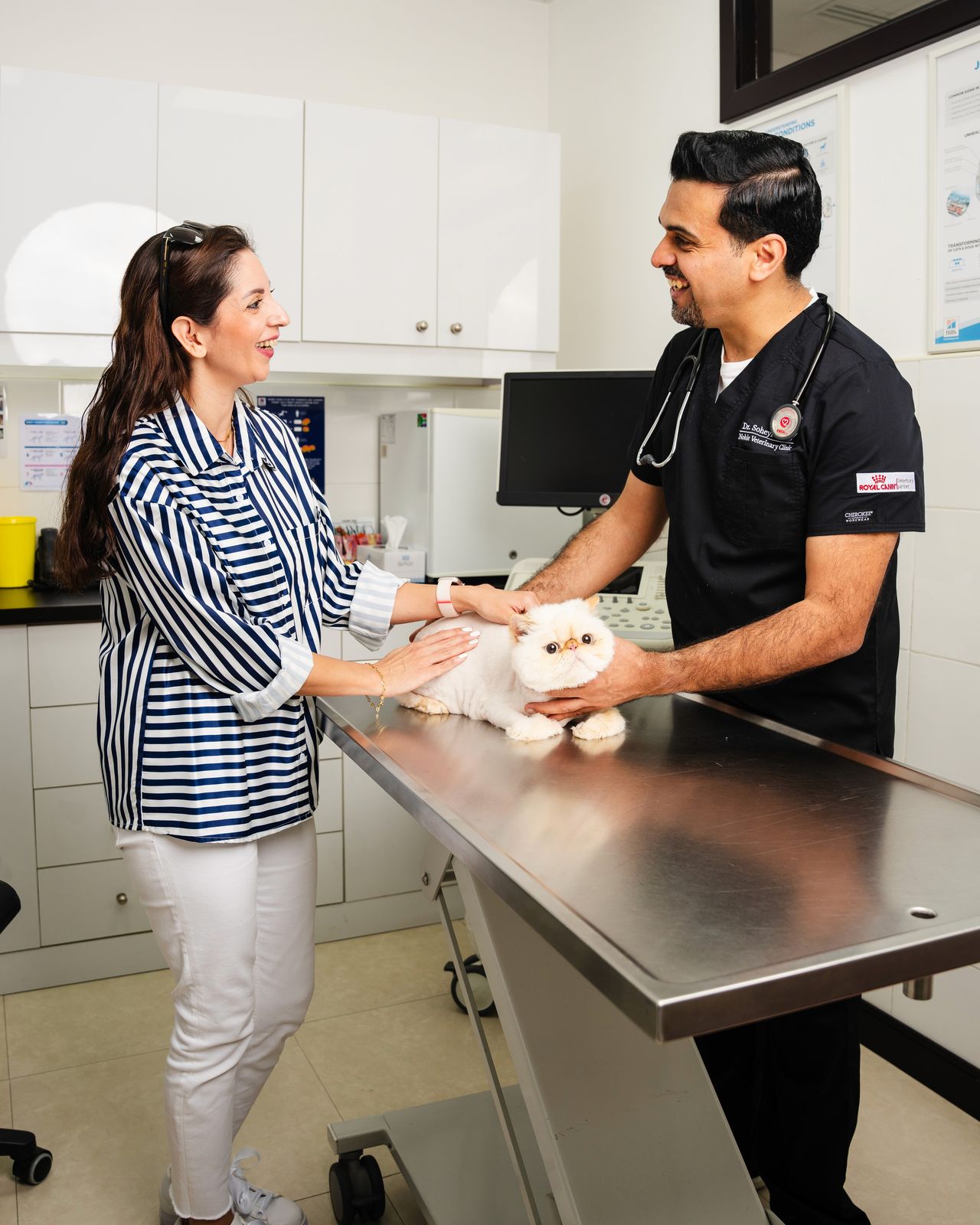
A Dubai vet discusses ringworm treatment options in cats with a pet owner during a consultation.

How Do Cats Get a Ringworm Infection

Cats get ringworm from contact with infected animals, people, or contaminated objects. This can happen when an infected cat plays with or grooms other healthy cats, or when healthy cats drink from contaminated water bowls, bedding, and toys.

In Dubai specifically, this makes certain everyday spots genuinely higher risk. Unhygienic boarding facilities, daycares, and grooming salons are common environmental sources, and fungal spores can survive on objects and surfaces for 12 to 18 months, meaning a poorly cleaned space stays risky for a long time, not just on the day of exposure. Given how many cat owners in Dubai rely on boarding and grooming services as part of normal pet care in a city environment, hygiene standards at these facilities matter more here than they might somewhere with fewer shared pet spaces.

This is exactly why we control our own environment closely. At our cat boarding facility in DIP, rooms are cleaned daily and kept separate from general clinic traffic specifically to reduce this kind of cross-contamination risk. Our grooming services follow the same standard, since we know grooming salons are one of the more commonly cited risk points for ringworm transmission.

Poor hygiene is a significant risk factor for transmission, whichever facility a cat visits, which is why it's worth asking any boarding or grooming provider directly about their cleaning protocols.

Community and Street Cats

Dubai has a large population of community and street cats, and anyone who regularly feeds strays or has recently adopted a rescued cat is at genuinely higher risk. Street cats have far more exposure to other infected animals and contaminated environments than cats living entirely indoors, so if you feed community cats or have brought one home, it's worth being extra attentive to early signs.

Newly Adopted Cats

Cats from shelters and rescues are more likely to arrive with ringworm than cats from a single-owner home, simply because shelters house many animals in close contact. This isn't a reason to avoid adopting, but it is a reason to keep a new arrival separate from other pets for the first couple of weeks and watch closely for symptoms, rather than assuming a clean bill of health by default.

Summer Boarding Season

Ringworm cases tend to rise during Dubai's summer months, when many families travel, and boarding facilities fill up. More cats passing through the same shared spaces in a short window means more opportunities for spores to spread, so it's worth being particularly diligent about a boarding facility's cleaning standards if you're booking during peak summer travel.

Can I Catch Ringworm From My Cat

Yes. Ringworm is zoonotic, and this is probably the single biggest reason cat owners search for this topic in the first place, so it's worth addressing directly.

In humans, ringworm typically appears as a red, itchy, ring-shaped rash with a clearer patch of skin in the centre, most often on the arms, hands, or neck, anywhere that's had direct contact with an infected cat or contaminated surface.

Children, elderly people, and anyone with a weakened immune system are most at risk, both of catching it and of experiencing a more persistent infection. If anyone in your household falls into one of these groups, it's worth being extra careful about handwashing after handling your cat and avoiding direct skin contact with visibly affected areas until treatment is underway.

If you or a family member develops a suspicious rash while your cat is being treated for ringworm, it's worth mentioning to your own doctor that your cat has a confirmed diagnosis; this can speed up getting the right treatment for you as well.

Which Cats Are Most at Risk

While all cats can get ringworm, young kittens, seniors, and immunocompromised cats are among the most at risk. Cats with diseases such as feline immunodeficiency virus or feline leukemia virus have suppressed immune systems, making them vulnerable to an infection.

Another risk factor is a cat's living conditions and lifestyle. Indoor cats are much safer, while outdoor cats have a higher chance of exposure to ringworm spores. 

Lastly, cats without sufficient basic care options will be at risk of feline ringworm. This includes the lack of nutrition, grooming, and preventive care.
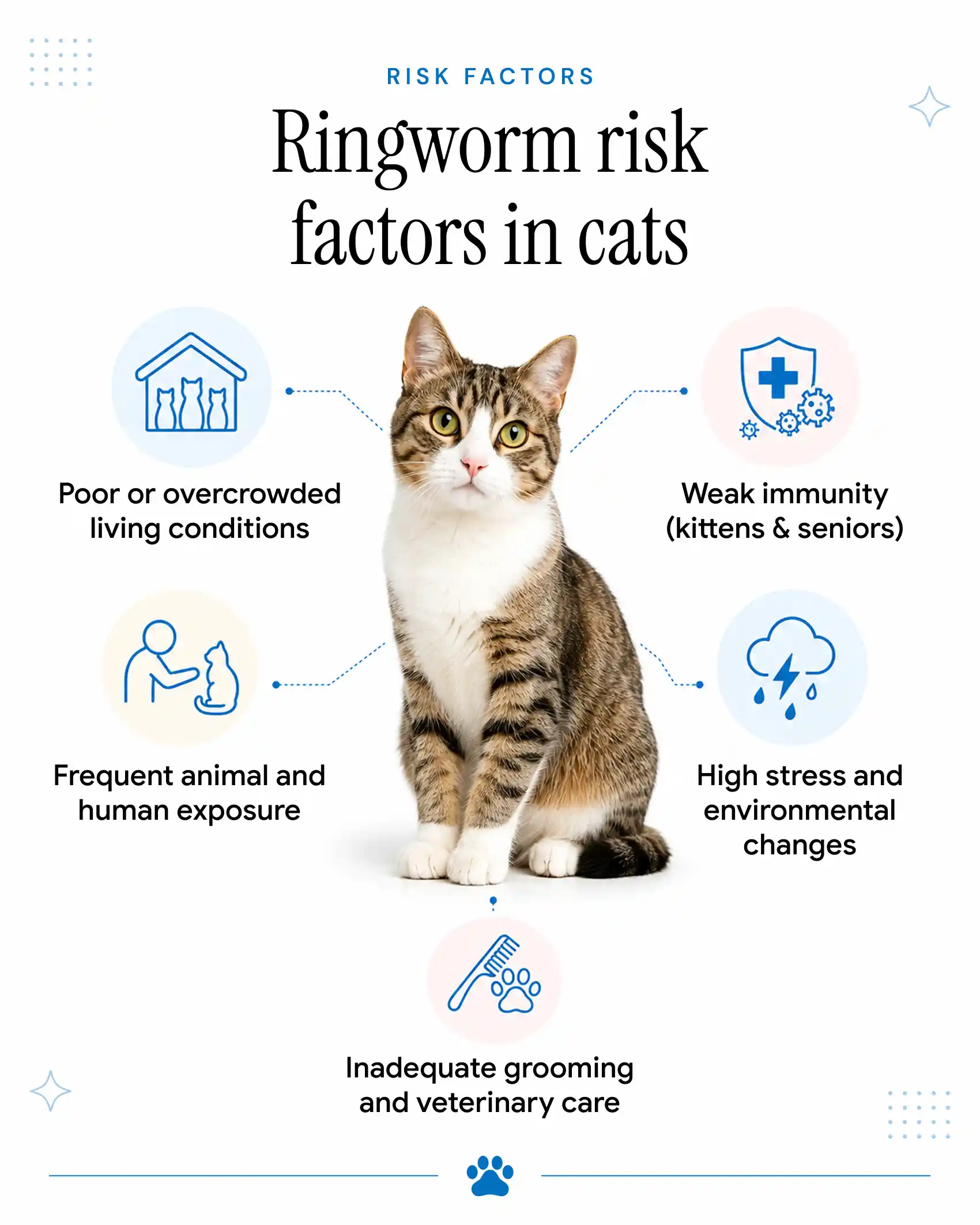
An infographic showing risk factors for ringworm in cats, including age, immune health, and lifestyle.

Notice any of the signs?

Notice any of the signs?

Let our vets look into it.

Let our vets look into it.

How Is Ringworm Diagnosed

Our dermatology experts can perform a Wood's lamp examination, microscopic examination, fungal culture, or a PCR test.

"A Wood's lamp examination involves using an ultraviolet light to examine your cat's fur. Some infected hair shafts may fluoresce a yellow-green or apple-green colour, although not all cases will glow under the lamp," says Dr. Soheyl.

Our vets may also take samples of hair and skin scrapings for direct microscopic examination, checking for fungal spores or hyphae, the branching structures of fungi. This rapid test has limited sensitivity of roughly 59%, so it's often used alongside other methods rather than on its own.

"The most definitive way to diagnose ringworm in cats is through a culture. This will be done in our in-house laboratory," says Dr. Soheyl.

Samples are cultured on dermatophyte test medium and incubated in the dark for 10 to 21 days, allowing us to accurately identify the fungal species involved.

A PCR test is also an option, offering over 95% sensitivity with results typically delivered in 1 to 3 days. A skin biopsy may be considered for unusual or atypical lesions if another condition is suspected.

How Is Ringworm in Cats Treated

A combination of oral medications, topical therapy, and strict environmental decontamination is required for ringworm treatment. The process takes 6 weeks or more, depending on each cat's case.

Oral Treatment

Common oral medications include itraconazole and terbinafine, effective at treating moderate or widespread infections and stopping the fungus from reproducing.

Topical Therapy

Our vets may prescribe lime sulfur dips or shampoos containing miconazole and chlorhexidine. Whole-body rinses and shampoos help kill spores across the entire cat, while creams and ointments treat localised areas directly.

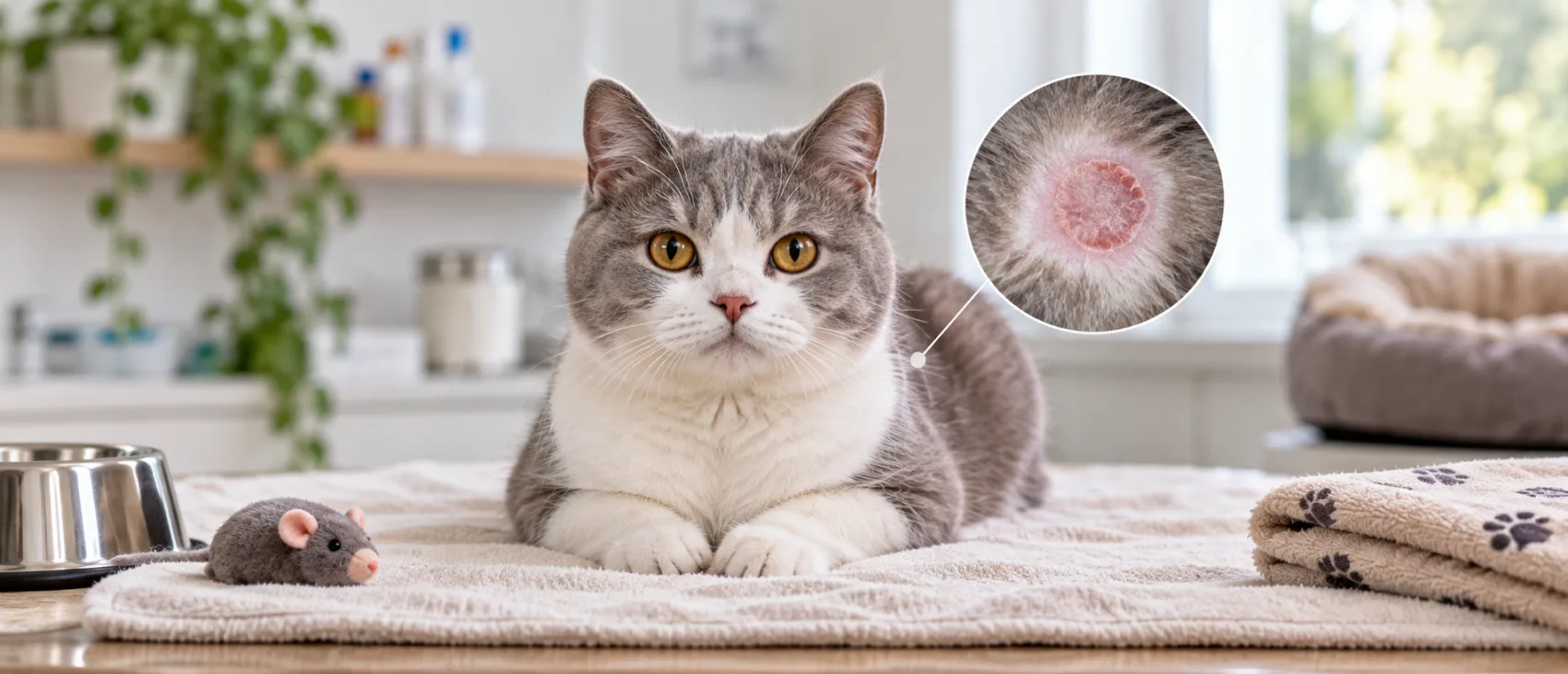
Two vets prepare a grey cat for a ringworm checkup and skin scraping test at Noble Veterinary Clinics.

How Do You Get Rid of Ringworm in Your Home

Your cat's environment needs to be cleaned and decontaminated alongside medical treatment; this isn't a separate, optional step; it's part of the treatment itself. Since ringworm spores can survive in a home for months, skipping this step is one of the most common reasons ringworm keeps coming back after a cat seems to have recovered.

Here's what that actually involves:

  • Wash bedding, blankets, and pillows weekly in hot water with a strong detergent, for the whole household, not just your cat's own bedding.

  • Vacuum carpets and soft surfaces regularly, and dispose of the vacuum bag or empty the canister immediately afterwards rather than letting it sit.

  • Disinfect hard surfaces with a diluted bleach solution or a product containing chlorine bleach.

  • Isolate your cat in one easy-to-clean room during treatment, since infected hairs shed spores throughout any space your cat has access to.

  • Keep your cat indoors for the full treatment period, both to protect other animals and to make decontamination manageable.

    “Ringworm is a stressful experience for our cats. The health of their skin is a big part of their overall health and happiness.”

    - Dr. Paulina Czerska

Recovery Timeline

Treating ringworm in cats takes patience and consistency. Here’s a general recovery timeline to help guide your expectations:

  • Week 1. It's common to see little to no visible change yet, even with treatment working exactly as it should. This is the point where owners most often worry treatment "isn't working," but the fungus needs time to respond; seeing no improvement this early isn't a sign of a problem.

  • Weeks 2 to 4. Your cat will gradually start showing signs of recovery, especially with proper treatment, though visible lesions often take several more weeks to fully clear.

  • Weeks 5 to 6. Some cats are nearly fully recovered by this point, while others need more time. It's important to follow the full course of treatment even if things look better.

  • Weeks 6+. This stage is about confirming healing. Treatment is often only stopped after two consecutive negative fungal cultures, as directed by your vet.

Even after visible symptoms clear, some cats may still carry spores, which is why repeated fungal testing is recommended before reintroducing your cat to other pets.

How to Prevent Ringworm in Cats

Since ringworm spores can remain in a cat's environment for extended periods of time, good preventive habits matter just as much as treatment itself.

New or foster cats should be checked by your vet and kept separate from your other pets at first, since some cats carry and shed spores without showing symptoms themselves.

For their personal hygiene, bathe your cat once every 4–6 weeks using a vet-approved shampoo. However, remember to avoid overbathing them, as this can dry out their skin and make it more vulnerable. You should also feed your cat a high-quality diet to keep their skin and coat healthy.

If you use a boarding or grooming service, ask about their cleaning protocols. At Noble, our DIP boarding rooms are cleaned daily and our grooming team follows strict hygiene standards, since these are common places for ringworm to spread between cats.

How Is Ringworm Diagnosed

Our dermatology experts can perform a Wood's lamp examination, microscopic examination, fungal culture, or a PCR test.

"A Wood's lamp examination involves using an ultraviolet light to examine your cat's fur. Some infected hair shafts may fluoresce a yellow-green or apple-green colour, although not all cases will glow under the lamp," says Dr. Soheyl.

Our vets may also take samples of hair and skin scrapings for direct microscopic examination, checking for fungal spores or hyphae, the branching structures of fungi. This rapid test has limited sensitivity of roughly 59%, so it's often used alongside other methods rather than on its own.

"The most definitive way to diagnose ringworm in cats is through a culture. This will be done in our in-house laboratory," says Dr. Soheyl.

Samples are cultured on dermatophyte test medium and incubated in the dark for 10 to 21 days, allowing us to accurately identify the fungal species involved.

A PCR test is also an option, offering over 95% sensitivity with results typically delivered in 1 to 3 days. A skin biopsy may be considered for unusual or atypical lesions if another condition is suspected.

How Is Ringworm in Cats Treated

A combination of oral medications, topical therapy, and strict environmental decontamination is required for ringworm treatment. The process takes 6 weeks or more, depending on each cat's case.

Oral Treatment

Common oral medications include itraconazole and terbinafine, effective at treating moderate or widespread infections and stopping the fungus from reproducing.

Topical Therapy

Our vets may prescribe lime sulfur dips or shampoos containing miconazole and chlorhexidine. Whole-body rinses and shampoos help kill spores across the entire cat, while creams and ointments treat localised areas directly.

Two vets prepare a grey cat for a ringworm checkup and skin scraping test at Noble Veterinary Clinics.

How Do You Get Rid of Ringworm in Your Home

Your cat's environment needs to be cleaned and decontaminated alongside medical treatment; this isn't a separate, optional step; it's part of the treatment itself. Since ringworm spores can survive in a home for months, skipping this step is one of the most common reasons ringworm keeps coming back after a cat seems to have recovered.

Here's what that actually involves:

  • Wash bedding, blankets, and pillows weekly in hot water with a strong detergent, for the whole household, not just your cat's own bedding.

  • Vacuum carpets and soft surfaces regularly, and dispose of the vacuum bag or empty the canister immediately afterwards rather than letting it sit.

  • Disinfect hard surfaces with a diluted bleach solution or a product containing chlorine bleach.

  • Isolate your cat in one easy-to-clean room during treatment, since infected hairs shed spores throughout any space your cat has access to.

  • Keep your cat indoors for the full treatment period, both to protect other animals and to make decontamination manageable.

    “Ringworm is a stressful experience for our cats. The health of their skin is a big part of their overall health and happiness.”

    - Dr. Paulina Czerska

Recovery Timeline

Treating ringworm in cats takes patience and consistency. Here’s a general recovery timeline to help guide your expectations:

  • Week 1. It's common to see little to no visible change yet, even with treatment working exactly as it should. This is the point where owners most often worry treatment "isn't working," but the fungus needs time to respond; seeing no improvement this early isn't a sign of a problem.

  • Weeks 2 to 4. Your cat will gradually start showing signs of recovery, especially with proper treatment, though visible lesions often take several more weeks to fully clear.

  • Weeks 5 to 6. Some cats are nearly fully recovered by this point, while others need more time. It's important to follow the full course of treatment even if things look better.

  • Weeks 6+. This stage is about confirming healing. Treatment is often only stopped after two consecutive negative fungal cultures, as directed by your vet.

Even after visible symptoms clear, some cats may still carry spores, which is why repeated fungal testing is recommended before reintroducing your cat to other pets.

How to Prevent Ringworm in Cats

Since ringworm spores can remain in a cat's environment for extended periods of time, good preventive habits matter just as much as treatment itself.

New or foster cats should be checked by your vet and kept separate from your other pets at first, since some cats carry and shed spores without showing symptoms themselves.

For their personal hygiene, bathe your cat once every 4–6 weeks using a vet-approved shampoo. However, remember to avoid overbathing them, as this can dry out their skin and make it more vulnerable. You should also feed your cat a high-quality diet to keep their skin and coat healthy.

If you use a boarding or grooming service, ask about their cleaning protocols. At Noble, our DIP boarding rooms are cleaned daily and our grooming team follows strict hygiene standards, since these are common places for ringworm to spread between cats.

Frequently Asked Questions

How long will a cat have ringworm?

With consistent veterinary advice and treatment, ringworm may last for just 4 to 6 weeks. Severe cases may take several months.

How long will a cat have ringworm?

With consistent veterinary advice and treatment, ringworm may last for just 4 to 6 weeks. Severe cases may take several months.

Are some breeds prone to this condition?

Himalayan and Persian cats are known to be prone to ringworm because their skin has a harder time fighting off the fungus. Long-haired cats with thick coats are also at risk since their coat can easily trap fungal spores.

Are some breeds prone to this condition?

Himalayan and Persian cats are known to be prone to ringworm because their skin has a harder time fighting off the fungus. Long-haired cats with thick coats are also at risk since their coat can easily trap fungal spores.

Can ringworm resolve on its own?

Technically, yes. However, it may take anywhere from 3 months to a year for a cat's immune system to clear the infection entirely. During this time, your cat will remain highly contagious to humans and other pets.

Can ringworm resolve on its own?

Technically, yes. However, it may take anywhere from 3 months to a year for a cat's immune system to clear the infection entirely. During this time, your cat will remain highly contagious to humans and other pets.

Is ringworm painful for cats?

It's not typically painful, but affected cats do experience intense irritation and itching. Ringworm causes dry, crusty skin, which can be very uncomfortable.

Is ringworm painful for cats?

It's not typically painful, but affected cats do experience intense irritation and itching. Ringworm causes dry, crusty skin, which can be very uncomfortable.

Can cats have ringworm without showing symptoms?

Yes, some cats may not show any symptoms. They're known as asymptomatic carriers; they can still harbour and spread fungal spores even without visible signs, which is part of why environmental decontamination matters even in mild-looking cases.

Can cats have ringworm without showing symptoms?

Yes, some cats may not show any symptoms. They're known as asymptomatic carriers; they can still harbour and spread fungal spores even without visible signs, which is part of why environmental decontamination matters even in mild-looking cases.

We're Glad You're Here

We're Glad You're Here

We're Glad You're Here

Get 150 AED Off Your Pet's First Visit

Share

Share

Custom Icon
Custom Icon
Custom Icon

Subscribe to Our Newsletter

Sign up for weekly pet health tips and insights from our veterinarians.

Sign up for weekly pet health tips and insights from our veterinarians.

Wellness & Emergency Care

Book Appointment

Worried about your pet?

We’re here for urgent care, wellness checks, or anything in between. 

At Noble Vet Clinic, we support lifelong pet wellness and the relationships that make it meaningful.

Why work at Noble! Let’s transform the future of veterinary care together.

Why work at Noble! Let’s transform the future of veterinary care together.

Why work at Noble! Let’s transform the future of veterinary care together.

Why work at Noble!

Noble Vet Clinics logo
Guided by Passion,
Backed by Veterinary Excellence
Instagram icon
Facebook icon
LinkedIn icon
TikTok icon

© 2006-2026 Noble Veterinary Clinics

Noble Vet Clinics logo
Guided by Passion,
Backed by Veterinary Excellence

Policies

Contact Us

DIP - 8am to 9pm
JLT - 10am to 7pm

Jumeirah - 8am to 8pm

Sports City - 9am to 7pm

Sustainable City - 9am to 6pm

Instagram icon
Facebook icon
LinkedIn icon
TikTok icon

© 2006-2026 Noble Veterinary Clinics

Noble Vet Clinics logo

Policies

Contact Us

DIP - 8am to 9pm
JLT - 10am to 7pm

Jumeirah - 8am to 8pm

Sports City - 9am to 7pm

Sustainable City - 9am to 6pm

© 2006-2026 Noble Veterinary Clinics