RELIEF FOR SENSITIVE SKIN
Pet Dermatology and Allergy Care in Dubai
Scratching, hair loss and ear infections are often the first sign of an allergy or a deeper problem. Allergies are managed, not cured, and we build a plan that keeps your pet comfortable for the long run.
or call us on

skin cases are triggered by environmental allergens.
7 out of 10
In the UAE,
Key Insight
RELIEF FOR SENSITIVE SKIN
Pet Dermatology and Allergy Care in Dubai
Scratching, hair loss and ear infections are often the first sign of an allergy or a deeper problem. Allergies are managed, not cured, and we build a plan that keeps your pet comfortable for the long run.
or call us on
skin cases are triggered by environmental allergens.
7 out of 10
In the UAE,
Key Insight
RELIEF FOR SENSITIVE SKIN
Pet Dermatology and Allergy Care in Dubai

skin cases are triggered by environmental allergens.
7 out of 10
In the UAE,
Key Insight
RELIEF FOR SENSITIVE SKIN
Pet Dermatology and Allergy Care in Dubai
Scratching, hair loss and ear infections are often the first sign of an allergy or a deeper problem. Allergies are managed, not cured, and we build a plan that keeps your pet comfortable for the long run.
or call us on

skin cases are triggered by environmental allergens.
7 out of 10
In the UAE,
Key Insight
LOCAL TRIGGERS
Sand, dust, humidity
Year-round, indoors and out
TESTING
Skin, blood & allergy
All available in-house
CHECK-UP
Every 3-6 months
For ongoing conditions
CONSULTATION
290 AED
Skin, coat, & ear check
EARLY CLUES
Which signs should you watch for?
The same symptom can mean different things, so the pattern matters. Itching on the paws, belly or ears often points to an allergy.
Sudden, fast-spreading redness often indicates a hot spot, and it worsens the longer it goes untreated. Persistent odour or greasy skin usually means infection, and hair loss with visible specks often points to parasites. Chronic ear infections frequently share a cause with skin symptoms, so we check the ears too.
Several signs together, or no improvement, usually means the cause is still hidden.


OUR APPROACH
How we treat pet skin and allergy issues
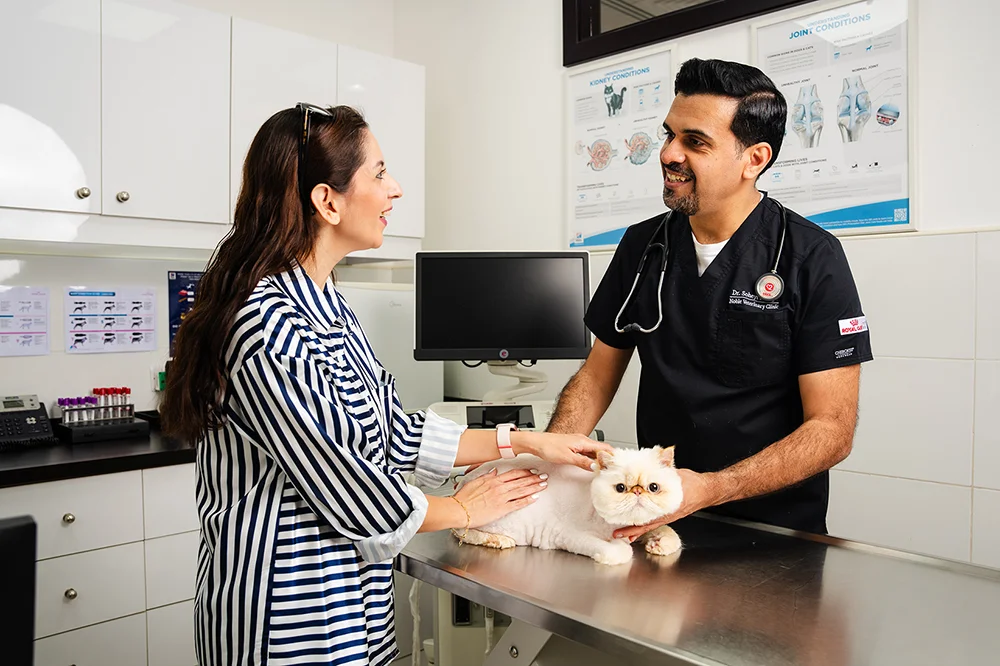
We start with a full exam of your pet’s skin, coat and ears, with skin scrapings or impressions where needed. Cytology, cultures and parasite checks follow to rule out infection, fleas, ticks and mites.
Food trials or allergy testing then pinpoint the trigger, so we treat the cause, not just the symptoms. Your plan is built around your pet, and may include medicated shampoos, creams, oral medication, immunotherapy or dietary changes.
Regular follow-ups let us track progress and adjust the plan as your pet’s needs change.
LOCAL TRIGGERS
What irritates pets in Dubai?
Many pets here react to the same few things, most of which are in the air around them.
Sand and dust
Fine particles settle on coats and paws
Year-round exposure
There is no off-season for allergens
Humidity
Warm, damp skin and ears invite yeast
Constant air conditioning
Dry indoor air strips moisture from skin
No real winter
Your pet's immune system never gets a break
Sand and dust
Fine particles settle on coats and paws
Year-round exposure
There is no off-season for allergens
Humidity
Warm, damp skin and ears invite yeast
Constant air conditioning
Dry indoor air strips moisture from skin
No real winter
Your pet's immune system never gets a break

FOR THE LONG RUN
Why do allergies need ongoing care?
A steady plan keeps flare-ups short and your pet comfortable.
LIFELONG
A condition we manage
Allergies are managed, not cured, so we aim for steady control and not a one-off fix.
Allergies are managed, not cured, so we aim for steady control and not a one-off fix.
EVERY 3 TO 6 MONTHS
Regular check-ups
We update the approach as your pet’s skin and needs shift, before small problems grow.
We update the approach as your pet’s skin and needs shift, before small problems grow.
OVER TIME
Treatment that adapts
We fine-tune shampoos, diet and immunotherapy, so many pets need fewer medicines over time.
We fine-tune shampoos, diet and immunotherapy, so many pets need fewer medicines over time.
Dr. Mafalda
Dr. Paulina
OUR DERMATOLOGY SPECIALIST
Dr. Mafalda Sardinha
Dr. Mafalda studied Medical Parasitology at the Institute of Hygiene and Tropical Medicine in Lisbon, so she knows what to look for when fleas, ticks or mites sit behind persistent itching.
With over two decades of experience in internal medicine and abdominal ultrasound, she looks past the skin to find what is driving the problem.
Veterinary Surgeon and Medical Director, Jumeirah branch
Postgraduate studies in Medical Parasitology, Institute of Hygiene and Tropical Medicine, Lisbon
20+ years of experience in internal medicine and abdominal ultrasound
Not sure why your pet keeps itching?
Let’s find out what’s causing it and how we can help.
Not sure why your pet keeps itching?
Let’s find out what’s causing it and how we can help.
Not sure why your pet keeps itching?
Let’s find out what’s causing it and how we can help.
Everything You Need to Know
Frequently Asked Questions
How long until my pet improves?
It depends on the cause. Infections and parasites often improve within days to a few weeks of treatment. Allergies take longer, because we first find the triggers and then fine-tune the plan. Many pets feel real relief in the first weeks, and steady control builds over a few months.
Can skin problems be a sign of something happening elsewhere in the body?
Sometimes, yes. Persistent skin issues can be the first visible sign of an internal problem, not just a surface-level irritation, which is part of why we look at the whole picture rather than treating the skin in isolation.
Why does a food trial take 8 to 12 weeks?
Your pet's skin needs time to heal and their immune system needs time to settle once the old food is out of their system. A shorter trial can give a false answer. During the trial, your pet eats only the trial diet, with no other treats or flavoured medication, so the result is reliable.
What can dermatology testing actually find that a general check-up might not?
A routine visit is built for a quick look; dermatology testing goes deeper, distinguishing between conditions that can look nearly identical on the surface but need completely different treatment. That precision is really the whole point of a dedicated consult.
Can pet allergies start later in life?
Yes. Allergies can appear at any age, even in pets that have never reacted before.
Can skin problems signal something elsewhere in the body?
Sometimes. Persistent skin issues can reflect an internal problem, so we look at the whole picture.
Can allergies be cured?
Not at present. Allergies are lifelong, so the goal is control: less itching, fewer flare-ups and less medication over time. For some pets, immunotherapy helps lower the reaction.

About
Services


© 2006-2026 Noble Veterinary Clinics
A Member of ARENA Veterinary Group
About
Services
© 2006-2026 Noble Veterinary Clinics
About
Services
© 2006-2026 Noble Veterinary Clinics
A Member of ARENA Veterinary Group